AARO "Western United States" UAP Case Resolution Report
Summary
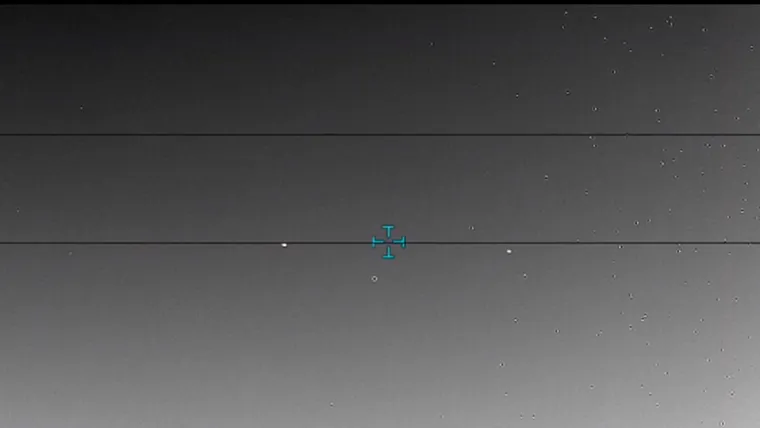
AARO's 'Western United States' case resolution (8 May 2023). AARO assesses five infrared lights reported in 2021 as a possible airspace incursion were almost certainly commercial aircraft as far as 300 nautical miles from the sensor.
Common questions
- What did AARO conclude about the five infrared lights reported over the western United States in 2021?
- AARO assesses the lights almost certainly were commercial aircraft traveling on established air corridors as far as 300 nautical miles from the sensor, not an incursion into restricted military airspace as initially reported.
- Why were the western United States objects misidentified as a possible airspace incursion?
- The report states the aircraft were far more distant than observers estimated, and their apparent shape changes resulted from sensor vibration and autofocus. Boresight analysis placed the aircraft at 20,000 to 40,000 feet at a comparable distance.
- What altitude were the western United States objects reported at?
- Military personnel reported five equidistant infrared lights at 20,000 to 40,000 feet. AARO and its partners confirmed the objects were commercial aircraft at comparable altitudes but far greater range.
Source & Classification
Record metadata
- Record type
- Report landing
- Decade
- 2020s
- Review status
- published
- Publication status
- published
Official source link
https://www.aaro.mil/UAP-Cases/UAP-Case-Resolution-Reports/Preservation copy (PDF) ⬇ · 502 KB · 2 pp A local preservation copy of this public-domain U.S.-government document. The official source above is authoritative.
Documents are linked to their official source pages, with a local preservation copy of the public-domain U.S.-government document where available; the official source is authoritative. Videos are linked, not hosted. Copyright and license notes are recorded per source.
Topics
Cite this record View collection →
All-domain Anomaly Resolution Office (AARO). "AARO "Western United States" UAP Case Resolution Report". 2020s. Official source: https://www.aaro.mil/UAP-Cases/UAP-Case-Resolution-Reports/. Cataloged by the independent UAP Records Archive (not an official or government source): https://uap-archive.org/uap/records/aaro-western-united-states/.
APA
All-domain Anomaly Resolution Office (AARO). (2020s). AARO "Western United States" UAP Case Resolution Report. https://www.aaro.mil/UAP-Cases/UAP-Case-Resolution-Reports/
MLA
All-domain Anomaly Resolution Office (AARO). "AARO "Western United States" UAP Case Resolution Report." 2020s, https://www.aaro.mil/UAP-Cases/UAP-Case-Resolution-Reports/.
Chicago
All-domain Anomaly Resolution Office (AARO). "AARO "Western United States" UAP Case Resolution Report." 2020s. https://www.aaro.mil/UAP-Cases/UAP-Case-Resolution-Reports/.
BibTeX
@misc{uaprecords_aaro-western-united-states,
  title  = {AARO "Western United States" UAP Case Resolution Report},
  author = {All-domain Anomaly Resolution Office (AARO)},
  year   = {2020s},
  howpublished = {Official source: https://www.aaro.mil/UAP-Cases/UAP-Case-Resolution-Reports/},
  note   = {Cataloged by the independent UAP Records Archive — not an official or government source},
  url    = {https://uap-archive.org/uap/records/aaro-western-united-states/}
}
Embed this record
Copy this HTML to embed the record card with attribution on your site.
<figure style="max-width:600px;margin:0;"> <a href="https://uap-archive.org/uap/records/aaro-western-united-states/"><img src="https://uap-archive.org/og/records/aaro-western-united-states.png" alt="AARO "Western United States" UAP Case Resolution Report — UAP Records Archive" width="600" style="width:100%;height:auto;border:0;" loading="lazy"></a> <figcaption style="font-size:13px;line-height:1.5;">All-domain Anomaly Resolution Office (AARO). "AARO "Western United States" UAP Case Resolution Report". 2020s. Official source: https://www.aaro.mil/UAP-Cases/UAP-Case-Resolution-Reports/. Cataloged by the independent UAP Records Archive (not an official or government source): https://uap-archive.org/uap/records/aaro-western-united-states/. <a href="https://uap-archive.org/uap/records/aaro-western-united-states/">View record →</a></figcaption> </figure>
Related records
Evidence
License note (source-level)
AARO content is US Department of Defense work, generally public domain under 17 U.S.C. §105. DoD seal and identity usage is governed by 18 U.S.C. §701 and DoD Directive 5410.20 and is not used by this archive. License treatment for specific linked documents will be assessed before any indexed or monetized release.
Archivist note
AARO’s case resolution report for the “Western United States” case, dated 8 May 2023. In 2021, military personnel reported five equidistant infrared lights at 20,000–40,000 feet as a potential incursion into restricted military airspace. AARO assesses the lights almost certainly were commercial aircraft on established air corridors as far as 300 nautical miles from the sensor.
The full English text below is machine-extracted from the linked PDF for reference; the original document is authoritative. This archive links the official source and an archive snapshot, and does not reproduce the DoD or AARO visual identity.
Full text (machine-extracted)
Uncertainty / Limits
Archive state (this release)
- Official source aaro.mil ↗
- Archived 2026-03-15 ↗
- Added to archive
- Last revised
- Record status
- Official link verified
- Review status
- published
- Publication status
- published
- Local copy
- Preservation copy hosted on this site
- Summary
- Published
- Translation
- Published — View in 中文 →
Verify this document (SHA-256)
This archive recorded the SHA-256 checksum of the source PDF. Download the document and recompute its checksum — a matching value means the file is byte-for-byte identical to the one this record cites:
SHA-256 · 846e51c849837276d8580cc2d2b683f015addc68f10994530b28f1be070b2f0a
Preservation copy: /uap/docs/aaro-western-united-states.pdf ↗
# macOS / Linux / WSL
sha256sum aaro-western-united-states.pdf

# Windows PowerShell
Get-FileHash aaro-western-united-states.pdf -Algorithm SHA256
A matching checksum means the file is byte-for-byte identical to the archived document. It does not verify the truth of any statement in the document — only the integrity of the file.