AARO "Go Fast" UAP Case Resolution Report
AARO Report landing 2010s Official link verified

Summary

AI-assisted summary — not an official document and not authoritative. It condenses the machine-extracted text; the original is the only authoritative source. Generated by summary:claude-opus-4-8@v1; last reviewed 2026-05-28.

AARO's 'Go Fast' case resolution (6 February 2025). AARO assesses with high confidence that the 2015 Navy infrared object did not move at anomalous speeds; its apparent high speed is an optical effect (motion parallax).

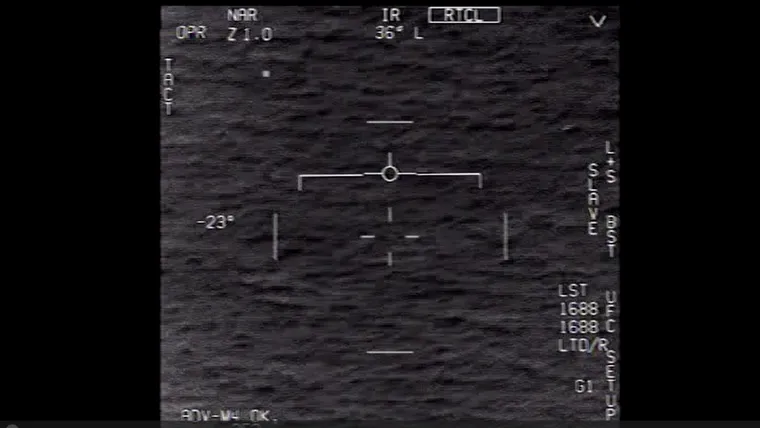
AARO's case resolution report for the U.S. Navy "Go Fast" video, dated 6 February 2025; the footage was recorded in January 2015 by an F/A-18F's forward-looking infrared (FLIR) sensor off the coast of Florida and released by the DoD in 2020. AARO assesses with high confidence that the object did not move at anomalous speeds: its altitude was about 13,000 feet and, after compensating for the wind, its speed was roughly 2 m/s (5 mph) to 41.3 m/s (92 mph). AARO attributes the appearance of high speed to motion parallax — an optical effect by which a slow-moving object viewed from a moving platform seems to move much faster. A technical appendix reconstructs the aircraft and object geometry from the publicly available video. AARO could not definitively identify the object but found it displayed no anomalous performance characteristics.

Common questions

What did AARO conclude about the speed of the Go Fast object?
The AARO report assesses with high confidence that the object did not move at anomalous speeds. Its altitude was approximately 13,000 feet and its wind-compensated speed roughly 2 m/s (5 mph) to 41.3 m/s (92 mph).
Why did the Go Fast object appear to move so fast in the video?
AARO attributes the apparent high speed to motion parallax — an optical effect by which a slow-moving object viewed from a moving sensor platform appears to move much faster.
What is the status of the Go Fast case?
The report states that AARO could not definitively identify the object but found it displayed no anomalous performance characteristics. The case is classified as resolved (attributed) in AARO's case-resolution series.

Source & Classification

Record metadata

Record type
Report landing
Decade
2010s
Review status
published
Publication status
published

Official source link

https://www.aaro.mil/UAP-Cases/UAP-Case-Resolution-Reports/

Documents are linked to official source pages; copyright and license notes are recorded per source. This archive does not embed PDFs or videos.

Topics

Cite this record

All-domain Anomaly Resolution Office (AARO). "AARO "Go Fast" UAP Case Resolution Report". 2010s. Official source: https://www.aaro.mil/UAP-Cases/UAP-Case-Resolution-Reports/. Cataloged by the independent UAP Records Archive (not an official or government source): https://uap-archive.org/uap/records/aaro-gofast-case-resolution/.

BibTeX

@misc{uaprecords_aaro-gofast-case-resolution,
  title  = {AARO "Go Fast" UAP Case Resolution Report},
  author = {All-domain Anomaly Resolution Office (AARO)},
  year   = {2010s},
  howpublished = {Official source: https://www.aaro.mil/UAP-Cases/UAP-Case-Resolution-Reports/},
  note   = {Cataloged by the independent UAP Records Archive — not an official or government source},
  url    = {https://uap-archive.org/uap/records/aaro-gofast-case-resolution/}
}

Evidence

License note (source-level)

AARO content is US Department of Defense work, generally public domain under 17 U.S.C. §105. DoD seal and identity usage is governed by 18 U.S.C. §701 and DoD Directive 5410.20 and is not used by this archive. License treatment for specific linked documents will be assessed before any indexed or monetized release.

Archivist note

AARO’s case resolution report for the “Go Fast” event, dated 6 February 2025. The video was recorded in January 2015 by a U.S. Navy F/A-18F pilot using a Forward Looking Infrared (FLIR) sensor off the eastern coast of Florida, and was officially released by the Department of Defense in 2020. The case is one of the three Navy videos most often discussed in public UAP coverage (alongside “FLIR1/Tic Tac” and “Gimbal”).

According to AARO, it assesses with high confidence that the object did not move at anomalous speeds: its altitude was about 13,000 feet and its wind-compensated speed about 2 m/s (5 mph) to 41.3 m/s (92 mph), with the apparent high speed attributable to motion parallax (a moving-sensor optical effect). The report includes a technical appendix detailing the FLIR-video geometry, wind modeling, and calculations.

The full English text below is machine-extracted from the linked PDF for reference; the original document is authoritative. This archive links the official source and an archive snapshot, and does not reproduce the DoD or AARO visual identity.

Full text (machine-extracted)

Machine-extracted text (tool: unpdf@1.6.2), reviewed by user:opus-review on 2026-05-28. Derived from the linked PDF; the original PDF (see official source / archive) is authoritative.

<!-- p.1 --> UNCLASSIFIED UNCLASSIFIED All-domain Anomaly Resolution Office U.S. Department of Defense Case: “Go Fast” Case Resolution | February 6, 2025 Case Overview In January 2015, a U.S. Navy F/A-18F pilot recorded an object using a Forward Looking Infrared (FLIR) sensor about 13,000 feet above the Atlantic Ocean off the coast of Florida. The video appeared to show the object moving at high speed. AARO cannot definitively identify the object, but it displayed no anomalous performance characteristics. The Department of Defense officially released the “Go Fast” video in 2020. It is available for public viewing at the Navy’s FOIA Reading Room. Key Findings AARO assesses with high confidence that the object did not move at anomalous speeds. AARO's analysis showed: • The object’s altitude was approximately 13,000 feet. • The object’s speed ranged from about 32 m/s (72 mph) to 72 m/s (161 mph) depending on its heading relative to the wind. Compensating for the wind’s contribution to the object’s speed, its approximate speed range is 2 m/s (5 mph) to 41.3 m/s (92 mph). • The object’s heading deviated as much as 32° from wind direction, though most simulations conducted during AARO’s analysis showed significantly less difference. The object did not move against the wind in any simulation. Case Essentials Location: Eastern coast of Florida Date: January 2015 Object Altitude (reported): Near ocean’s surface Object Altitude (assessed): 13,000 feet Object Speed (reported): Appeared to move at high speeds Object Speed (assessed): 5 mph - 92 mph Object Shape (reported): Round Object Shape (assessed): Spherical or oblate ellipsoid Reporter: U.S. Navy Sensor: Forward Looking Infrared Reported Behavior: Moved at high speeds near the ocean’s surface Assessed Behavior: An object moving between 5 and 92 mph at approximately 13,000 feet Summary of Findings: High confidence the object did not demonstrate anomalous performance characteristics <!-- p.2 --> UNCLASSIFIED 2 UNCLASSIFIED Determining the object’s true speed and direction of travel (heading) requires knowing the F/A- 18F’s heading. AARO calculated the object’s speed and heading relative to the aircraft because the video display does not contain the aircraft’s heading. AARO calculated the object’s position and direction of travel for the entire range of possible wind directions (0° - 360°) to account for differences in atmospheric conditions between the F/A-18F’s altitude and object’s altitude. This comprehensive modeling informed AARO’s assessment of whether the object moved with or against the wind and whether it behaved anomalously for all possible directions of travel. AARO factored in historical wind speeds and directions at both the object’s altitude (13,000 feet) and the aircraft’s altitude (25,000 feet), as measured near the time and location of the event: • At 13,000 feet, wind speed was 30.9 m/s (69 mph) from the west (265°). • At 25,000 feet, wind speed was 52 m/s (116 mph) from the west southwest (255°). Figure 1 shows the object’s range of possible speeds calculated while compensating for wind speed at 13,000 feet. This is considered the “intrinsic” speed. An intrinsic speed of 0 m/s indicates that the object is moving with the wind, or about 30.9 m/s. Figure 1: The y-axis represents the object’s speed with wind effects removed. The x-axis represents the wind’s heading relative to the F/A-18F’s airframe geometry (0° is a headwind). The curve represents the object’s range of speeds at each angle. The tailwind, headwind, and crosswind cases are denoted by the colored lines. The object’s lowest possible speed occurs near a headwind while the highest occurs in a tailwind. Figure 2 shows the object’s range of possible headings relative to the wind direction at 13,000 feet. A direction of 0° indicates that the object is moving in the same direction as the wind. <!-- p.3 --> UNCLASSIFIED 3 UNCLASSIFIED Figures 1 and 2 can be used to find the object’s speed and heading compared to the wind for any direction of the F/A-18F’s travel relative to the prevailing wind direction. As examples, the object’s apparent speed and direction is summarized here for four scenarios: headwind, crosswind from the left, tailwind, and crosswind from the right. 1. Headwind (aircraft flying into the wind): The object moved 2.0 m/s (5 mph) faster than the wind, at a heading of ° 5° off-wind. 2. Left Crosswind (wind coming from the left side): The object moved 26.5 m/s (59 mph) faster than the wind, heading 31.5° off-wind. 3. Tailwind (aircraft flying with the wind): The object moved 41.3 m/s (92 mph) faster than the wind, heading 12.3° off-wind. 4. Right Crosswind (wind coming from the right side): The object moved 27.7 m/s (62 mph) faster than the wind, heading 9.5° off-wind. The object’s performance characteristics are consistent with historical wind conditions in each scenario. AARO assesses the object did not demonstrate anomalous performance characteristics. The object’s apparent high speed is attributable to motion parallax. Motion parallax is an optical effect that induces an observer to perceive that a stationary or slow-moving object is moving much faster than that the subject object’s actual speed when viewed from a moving frame of Figure 2: The y-axis represents the difference between the object’s heading and the wind direction at 13,000 feet. The x-axis represents the wind’s heading relative to the F/A-18F’s airframe geometry (0° is a headwind). The curve represents the object’s range of possible directions compared to the wind. The tailwind, headwind, and crosswinds are denoted by the colored lines. The maximum deviation in the UAP’s direction of travel from wind direction is 32.1°. <!-- p.4 --> UNCLASSIFIED 4 UNCLASSIFIED reference. The more quickly an observer moves relative to an observed object, the more pronounced this effect is. Data Quality and Methodology AARO analyzed the publicly available 34-second FLIR video, because the original file and its accompanying metadata are no longer available. The video display provided sufficient information to assess the object’s altitude and a range of possible speeds. The display showed: • The range (distance) from the FLIR sensor to the target. • The FLIR camera’s azimuth (left-right angle) and elevation (up-down angle). • The aircraft's altitude, speed, and tilt (bank angle). The aircraft’s exact location and heading (compass direction) during the recording are unknown. AARO could not calculate a single speed or heading for the object because the aircraft’s calculated flight path depends on its exact heading, and the object’s calculated location depends on the aircraft’s location. Instead, the analysis considered all possible aircraft headings (from 0° to 360°) to calculate a range of possible speeds and headings for the object. These calculations include a small margin of error, because the range from the sensor to the object and the sensor angles are only accurate to a single decimal place. AARO could not determine the object’s size due to the video’s low resolution and the range from the sensor to the object. However, pixel analysis (a method of measuring an object’s size based on pixels relative to an object known dimensions) by AARO’s Intelligence Community partner suggested the object was one meter or less in size - comparable to a small drone or bird. For more technical details on assumptions and methodology, see Appendix A: Estimating UAP Location, Speed, and Heading from “Go Fast” FLIR Video Data. <!-- p.5 --> UNCLASSIFIED 5 UNCLASSIFIED Appendix A: Estimating UAP Location, Speed, and Heading from “Go Fast” FLIR Video Data February 2025 Introduction In 2024, the All-domain Anomaly Resolution Office (AARO) estimated possible altitude, speed, and heading solutions for an unidentified anomalous phenomenon (UAP), commonly known as “Go Fast.” The executive summary, general overview, and conclusions are provided in the AARO “Go Fast” Case resolution [ref 1]. This paper presents a more in-depth data analysis for those interested in the mathematics and calculations applied to the forward-looking infrared (FLIR) video footage captured by an AN/ASQ sensor pod onboard the F/A-18 Super Hornet observing the event in January 2015. AARO manually extracted data from a publicly available video of the “Go Fast” event as the source material to conduct its analysis. Video footage collected via military sensors, like the AN/ASQ, are not required to collect Full- Motion Video (FMV) or other Intelligence Surveillance and Reconnaissance (ISR) products. Therefore, it is not intended to support intelligence or other rigorous analysis. Thus, video footage from these platforms often contains compression artifacts or lacks the necessary metadata to conduct an exhaustive analysis. For proper FMV products, standard analysis is done using software packages such as SOCET GXP [ref 2]. SOCET GXP is a suite of geospatial analytic software tools that utilize satellite and airborne imagery to measure and detect objects and phenomena. Generally, FMV is used to track objects on the surface of the earth such as road vehicles, ships, and tanks. In these cases, an object’s location can be determined since an FMV sensor knows where it is and where it is pointed and can then calculate the distance to the ground point. In the case of the “Go-Fast” video, the object is not on the ground and the sensor/aircraft location is not provided in the metadata. Despite these limitations, the basic techniques used in FMV analysis can be applied with some alteration for analyzing UAP cases. AARO reconstructed the F/A-18’s flight path and position and assessed possible trajectories of the “Go Fast” UAP using the mathematics, standard methods, and conventions defined in the National Geospatial-Intelligence Agency’s (NGA) Motion Imagery Standards Board’s UAS Datalink Local Set Standards (MISB ST 0601.19 dated March 02, 2023) [ref 3]. Step-by-step calculations are provided in this paper to estimate the motion characteristics of the UAP in the “Go Fast” event from the same video accessible by the public. <!-- p.6 --> UNCLASSIFIED 6 UNCLASSIFIED Data The only data available to AARO from the “Go Fast” event were from a compressed Windows Media File (.wmv) [ref 4]. The recording’s metadata does not contain the F/A-18’s georeferenced position and heading, which are necessary to determine the UAP’s absolute position and flight characteristics. The sensor display does contain enough information to find a speed, relative heading, and altitude of the UAP. These necessary pieces of information are the elevation angle of the sensor, the azimuth angle of the sensor, the range from the F/A-18 to the target, the F/A-18 altitude, the F/A-18 speed, and relative frame times. The sensor pod display shows most of these values as integers, limiting the fidelity of the initial calculations.1 The display is shown in Figure 1 with these fields labeled. Figure 3: One of the two frames used in the analysis with annotated fields indicate the data extracted from the video and used in calculations. To estimate the UAP speed, the first step was to determine its location at two positions separated by a known time period. For this, the range to the target must be known. From 4232 seconds until the end of the video, the tracker acquired a target track on the UAP, enabling the range to be reported. Within this portion AARO focused its analysis on a 13-second excerpt from the footage between 4239 seconds (“t1”) and 4252 seconds (“t2”). AARO selected this segment because, between t1 and t2, the aircraft’s bank angle, altitude, and airspeed remained nearly constant. This simplified the estimation of the F/A-18 flight characteristics due to the reduced number of variables. At t1, the F/A-18’s range to the UAP was 4.0 NM and closed in range to 3.4 NM at t2. 1 Following sections will outline a methodology to estimate values with more precision. <!-- p.7 --> UNCLASSIFIED 7 UNCLASSIFIED Table I contains the data extracted from the video footage at t1 and t2. Range and altitude were converted to metric units to maintain consistency in calculations. The F/A-18 bank angle was measured using the yellow lines drawn over the level flight and roll indicator lines in the display as depicted in Figure 1. This angle, denoted by θB, was approximately 14° from t1 to t2. An average aircraft altitude of 7,621 m was assumed over this time frame. The speed in Mach number was converted to m/s [ref 5] at the altitude of the F/A-18, resulting in an average speed of about 190 m/s over the time frame. Table I: Data extracted from frames at 4239 seconds and 4252 seconds in the “Go Fast” video. UAP Location Calculation Methodology This section contains step-by-step calculations for finding the UAP locations relative to the F/A- 18 at two points in the “Go Fast” UAP event. This provides the reader with a foundational understanding of the methodology and rough estimate of the speed and heading of the UAP. The methodology will then be applied to all frames in the t1 to t2 interval in a later section. Since the data do not provide an absolute location for the F/A-18 at t1, the aircraft was arbitrarily placed at a reference point that simplified the problem: the origin of an x-y-z cartesian coordinate system. The axes of this system were defined in a manner consistent with the MISB ST 0601.19 [ref 3, p. 12] and provided here in Figure 2. The aircraft longitudinal axis is the +x- axis, the transverse axis the +y-axis, and the vertical axis the +z-axis.Parameter Frame 1 Sensor Display Value Frame 1 Converted Frame 2 Sensor Display Value Frame 2 Converted Time 4239 sec 0 sec 4252 sec 13 sec Sensor Azimuth 49° 49° 57° 57° Sensor Elevation -29° -29° -35° -35° Range to Target 4.0 NM 7408 m 3.4 NM 6297 m Aircraft Altitude 25,000 ft 7620 m 25,010 ft 7623 m Aircraft Velocity 0.61 M 188 m/s* 0.62 M 191 m/s* *-assumes speed of sound (M=1) at 25,000 ft is 601 knots [ref 5] <!-- p.8 --> UNCLASSIFIED 8 UNCLASSIFIED Figure 4: The three axes defined relative to an air platform in FMV analysis. Longitudinal is the +x, Transverse is the +y, and Vertical is the +z (pointing down). This coordinate system was applied to the F/A-18 as depicted in Figure 3. Because the aircraft altitude was constant over the duration of flight, its path is level and confined to the x-y plane (z = 0). Figure 5: The top-down view coordinate system defined with the position of the F/A-18 at the origin with coordinates [0,0,0]. The aircraft is moving in the +x direction. With the position of the F/A-18 defined at t1, the location of the UAP relative to this position was calculated. This calculation was done by defining a line-of-sight (LOS) or “pointing” vector and then rotating this vector around the axes by the sensor azimuth and elevation angles given in Table I in order to point to the location of the UAP. The angle of rotation about the x-axis is the aircraft roll and is denoted by α; the angle of rotation about the y-axis is the “up and down” motion due to the aircraft pitch or sensor pointing <!-- p.9 --> UNCLASSIFIED 9 UNCLASSIFIED elevation and denoted by β; the angle of rotation about the z-axis is the “left and right” motion due to aircraft yaw or sensor pointing azimuth and denoted by γ. For this FLIR sensor, the bank (or roll) angle of the aircraft is included in the elevation and angles of the sensor and not treated separately. The reader is encouraged to consult [ref 3] for additional explanation of these angles. These rotations were carried out by applying 2-D rotation matrices derived from the underlying trigonometry [ref 6]. Equations (1), (2), and (3) provide these 3x3 rotation matrices about the x-, y-, and z-axes by the defined angles α, β, and γ respectively. 𝑅𝑥(𝛼) = [ 1 0 0 0 cos(𝛼) − sin(𝛼) 0 sin(𝛼) cos(𝛼) ] (1) 𝑅𝑦(𝛽) = [ cos (𝛽) 0 sin (𝛽) 0 1 0 − sin(𝛽) 0 cos(𝛽) ] (2) 𝑅𝑧(𝛾) = [ cos (𝛾) −sin (𝛾) 0 sin (𝛾) cos(𝛾) 0 0 0 1 ] (3) These rotations are relative to the aircraft attitude. Therefore, the initial LOS was defined as a unit vector pointing straight ahead from the F/A-18 along the +x-axis. This vector is represented in cartesian (x, y, z) vector notation as v = <1,0,0>. The vector’s magnitude is defined by the range to the UAP. Properly rotating, or pointing, this vector by the given sensor angles yields the UAP’s relative position to the aircraft. Position of UAP at t1 The length, or magnitude, of the LOS vector at t1 was defined by multiplying the unit vector v by the range to the target. At t1 the range was 7,408 m, thus the initial LOS vector was v1 = <7,408, 0, 0> m. The next step was to point this vector at the UAP. First, it was rotated by the sensor elevation (pitch) angle β around the y-axis: 𝑅𝑦(𝛽) ∙ 𝒗𝟏 = [ cos (𝛽) 0 sin (𝛽) 0 1 0 − sin(𝛽) 0 cos(𝛽) ] [ 7408 0 0 ] (4𝑎) = [ cos (−29°) 0 sin (−29°) 0 1 0 − sin(−29°) 0 cos(−29°) ] [ 7408 0 0 ] (4𝑏) <!-- p.10 --> UNCLASSIFIED 10 UNCLASSIFIED = [ 7408 ∙ cos(−29°) + 0 ∙ 0 + 0 ∙ sin (−29°) 7408 ∙ 0 + 0 ∙ 1 + 0 ∙ 0 7408 ∙ −sin(−29°) + 0 ∙ 0 + 0 ∙ cos (−29°) ] (4𝑐) = [ 6479 0 3591 ] (4𝑑) Next, the vector result from (4d) was rotated about the z-axis by the sensor azimuth, γ. Note that the sensor is pointing 49° to the left (designated by the “L”), which is a negative angle in the defined coordinate system. These calculations are provided in (5a-d): 𝑅𝑧(𝛾) ∙ 𝑣𝐿𝑂𝑆 = [ cos (𝛾) −sin (𝛾) 0 sin (𝛾) cos(𝛾) 0 0 0 1 ] [ 6479 0 3591 ] (5𝑎) = [ cos (−49°) −sin (−49°) 0 sin (−49°) cos(−49°) 0 0 0 1 ] [ 6479 0 3591 ] (5𝑏) = [ 6479 ∙ cos(−49°) + 0 ∙ − sin(−49°) + 3591 ∙ 0 6479 ∙ sin(−49°) + 0 ∙ cos (−49°) + 3591 ∙ 0 6479 ∙ 0 + 0 ∙ 0 + 3591 ∙ 1 ] (5𝑐) = [ 4251 −4890 3591 ] (5𝑑) The resulting vector <4,251, -4,890, 3,591> m means that the UAP was located 4,251 m ahead, 4,890 m to the left (the y-coordinate is negative), and 3,591 m below (the +z-axis is pointing down) the F/A-18. At 3,591 m below the F/A-18 the UAP was at an altitude of 4,029 m (13,219 ft). Location of UAP at t2 To find the UAP location at t2, the F/A-18 location had to be estimated based upon the known flight dynamics. Because the aircraft was banking at 14° between t1 and t2, it was turning in a curved path while moving at an average speed of 190 m/s. As it turned it also changed heading away from the +x-axis. This rotation away from the axis can be represented as a yaw angle of φ relative to its orientation at t1, as depicted in Figure 4. The curved path of the F/A-18 is essentially part of a circle. The radius of that circle, or radius of curvature, was found from (6). 𝑅𝑐 = 𝑣𝐹𝐴182 𝑔 ∙ tan(𝜃𝐵) (6) <!-- p.11 --> UNCLASSIFIED 11 UNCLASSIFIED Inserting vFA18 = 190 m/s, the acceleration of gravity g = 9.81 m/s2, and θB = 14° into (6), the radius of curvature Rc was found to be 14,759 m. These values are shown in Figure 4 with the radius of curvature and position of the F/A-18 at t2. Figure 6: The F/A-18 traveled in a curved path from its position at t1 to reach its position at t2. To find yaw the angle φ at t2, note that the two φ’s in Figure 4 are equal. The total distance traveled in the partial circle by the F/A-18 moving at 190 m/s over 13 seconds is 2,470 m. Had the aircraft kept flying to complete a circle, it would have traveled 2·π·Rc or 92,736 m. Therefore, only 2.66% of a 360° circle was completed thus φ = 9.6°. Since the yaw is counterclockwise, away from the positive y-axis, it is a negative value, or φ = -9.6°. To find the F/A-18’s position at t2, the Δx and Δy change in position from the location at t1 must be found. Equations (7) and (8) use a cylindrical coordinate transformation [ref 8] to do this. ∆𝑦 = 𝑅𝑐 − 𝑅𝑐 ∙ cos(𝜑) = 14,759 ∙ (1 − cos(9.6°)) = 207 𝑚 (7) ∆𝑥 = 𝑟 ∙ sin(𝜑) = 14,759 ∙ sin(9.6°) = 2461 𝑚 (8) Thus, at t2, the aircraft’s displacement was [2,461, -207, 0] m, or 2,461 meters ahead and 207 meters left2 of its t1 position. This will be used momentarily to find the UAP’s location at t2. At t2 the UAP was at a range of 6,279 m from the F/A-18 such that the pointing vector, v2, is given by <6,279, 0 ,0> m. As with t1, the LOS vector was defined as pointed in the direction of +x-axis, not the heading of the aircraft.3 At t2 the sensor elevation and azimuth angles were β = - 35° and γ = -57°, respectively. The additional yaw of the F/A-18 of -9.6° required one additional rotation.4 The rotation by -35° about the y-axis to the sensor elevation is given in (7a-7b).5 2 The negative is applied here to conform with our coordinate system. 3 This is not the direction the F/A-18 was pointed, otherwise there would be a y-component of the vector. The additional yaw angle will be handled in the rotation matrices. 4 The sensor azimuth and F/A-18 yaw could be added and performed in a single rotation. In general, the aircraft would have roll and pitch and adding the platform angle to the sensor angle may give an incorrect result. 5 The written-out step depicting the multiplication of the matrices is skipped here. <!-- p.12 --> UNCLASSIFIED 12 UNCLASSIFIED 𝑅(𝛽)𝑦 ∙ 𝐿𝑂𝑆 = [ cos (−35°) 0 sin (−35°) 0 1 0 − sin(−35°) 0 cos(−35°) ] · [ 6297 0 0 ] (9𝑎) = [ 5158 0 3612 ] (9𝑏) The rotation about the z-axis by -57° to account for the sensor azimuth is given (8a-8b). 𝑅𝑧(𝛾) ∙ 𝐿𝑂𝑆 = [ cos (−57°) −sin (−57°) 0 sin (−57°) cos(−57°) 0 0 0 1 ] ∙ [ 5158 0 3612 ] (10𝑎) = [ 2809 −4326 3612 ] (10𝑏) And finally, (9a-9b) show the rotation about the z-axis -9.6° for the aircraft yaw relative to position 1. 𝑅𝑧(𝛾) ∙ 𝐿𝑂𝑆 = [ cos (−9.6°) −sin (−9.6°) 0 sin (−9.6°) cos(−9.6°) 0 0 0 1 ] · [ 2809 −4326 3612 ] (11𝑎) = [ 2049 −4734 3612 ] (11𝑏) This means the UAP was 2,049 m ahead of, 4,734 m to the left of, and 3,612 m below the F/A- 18’s position at t2. We can now apply the coordinates for the F/A-18 from (7) and (8) to find the UAP location at t2. Adding the UAP’s relative coordinates from (9b) to the aircraft’s Δx and Δy displacement from t1 to t2 gives the UAP position. [2,049, −4,734, 3,612] + [2,461, −207, 0] = [4,510, −4,941, 3,612] (12) The UAP was 3,612 m below the F/A-18, or at an altitude of 4,008 m (13,150 ft), very close to the altitude at t1 indicating the UAP moved in a mostly level path. Results With the location of the UAP known at t1 and t2, the distance between the locations was calculated using the cartesian coordinate distance formula as shown in (13a-13c). 𝑑 = √(𝑥2 − 𝑥1)2 + (𝑦2 − 𝑦1)2 + (𝑧2 − 𝑧1)2 (13𝑎) <!-- p.13 --> UNCLASSIFIED 13 UNCLASSIFIED = √(4,510 − 4,251)2 + (−4,941 − (−4,890))2 + (3,612 − 3,591)2 (13𝑏) = √67,081 + 2,601 + 441 = 265 𝑚 (13𝑐) Dividing this distance by the 13 seconds elapsed between t1 and t2 gave an estimated speed of about 20 m/s or 45 mph. The heading of the UAP, φUAP, was also calculated from the Δx and Δy components of the locations. 𝜑𝑈𝐴𝑃 = tan−1 (Δ𝑦 Δ𝑥) = tan−1 ((−4,890 − (−4,941)) (4,251 − 4,510) ) = −11.14° (14) The UAP heading is forward along the +x-axis and slightly in the negative y direction, moving in the same general direction as the F/A-18 (-9.6°) but about 9 times slower. As a reminder, all depicted locations and directions are relative to the defined coordinate system. Referencing directions such as North, South, East, and West cannot be done without knowledge of the location or heading of the F/A-18. Estimating the UAP Path of Travel The previous sections explained the methodology used to calculate the positions of the UAP at the two endpoints of the time interval, t1 and t2. The resulting speed and relative heading assumed the UAP traveled in a mostly straight, direct path between these two points. The same mathematical approach was then applied to every frame of the thirteen-second video to estimate the continuous path of the UAP from the first to last points. This calculation required an estimate of the time, sensor azimuth and elevation, range to target, and the F/A-18 location for all frames in the period. The metadata did provide relative frame times, with 0.033 seconds elapsing between frames in the 30 Hz video. Path of the F/A-18 The F/A-18’s altitude, bank angle, and airspeed remained constant between t1 and t2. Therefore, the radius of the curvature of its flight path remained constant from (6). The distance traveled at each point in time was the elapsed frame time multiplied by the speed. Location and yaw were then calculated using the previously describe methods. Path of the UAP The sensor azimuth, sensor elevation, and range to the object were changing during the video. The sensor’s display indicated these changes in integers so that many frames would pass before a value was incremented or decremented. More accurate estimates were made by noting the frames and times when a quantity incremented or decremented. For example, in the frame that a <!-- p.14 --> UNCLASSIFIED 14 UNCLASSIFIED value changes from 50 to 51, the value in that frame must be 51.0 (or 50.56) in that frame. These “change frames” were identified for the sensor azimuth, sensor elevation, and range to target in the time interval from t1 to t2 and are represented by the black dots in the plots in Figures 5-8. The values for all frames between 4239 seconds and 4252 seconds were estimated by fitting a 2nd order polynomial curve to the datapoints. These curves are the dotted lines plotted in Figures 5-8 and are generally a very good fit through the black dots. The fit equation and R2 fit error estimate are also provided. An R2 equal to 1 would be a perfect fit to the data. Figure 7: The sensor azimuth “change frame” data points are plotted vs frame time. The dotted line was fit to the points to estimate the azimuth for all frames in the time interval. 6 Whether the value is 50.5 or 51.0 does not make a difference as the times and positions are all relative and speed is found by subtraction. An uncertainty error of 0.033 seconds remains for each frame but is negligible here. <!-- p.15 --> UNCLASSIFIED 15 UNCLASSIFIED Figure 8: The sensor elevation “change frame” data points are plotted vs frame time. The dotted line was fit to the points to estimate the elevation for all frames in the time interval. Figure 9: The range to target “change frame” data points are plotted vs frame time. The dotted line was fit to the points to estimate the range for all frames in the time interval. With values estimated for all frames and times, the vector rotation and point translation methodology described in the previous section were applied to find the UAP’s three-dimensional flight path. The resulting path through the x-y plane is plotted in Figure 8. The UAP’s direction of travel is a relatively straight path from the top left to the bottom right. The altitude profile is provided in Figure 9 and shows the UAP rising about 10 m (30 ft) with a slow, curving descent <!-- p.16 --> UNCLASSIFIED 16 UNCLASSIFIED near the end. The bends at the end of both curves may indicate a slight change of direction but is more likely due to residual error in the estimation of the F/A-18 flight path. Figure 10: The position of the UAP in the x-y plane is shown over the time considered. The direction of flight is from the upper left to the lower right. Figure 11: The altitude of the UAP as a function of time indicates a slow rise over most of the path with a slight descent in the last few seconds. The beginning and end points of the path defined by Figures 8 and 9 were compared to the results from the end-point analysis in the previous section to verify the path calculations are consistent and that the methodology was correctly applied. The results are provided in Table II <!-- p.17 --> UNCLASSIFIED 17 UNCLASSIFIED and show good agreement. Because the frame-by-frame method estimates the parameters to a better precision than just integers and more accurately assigns the time to each value, it is presumed that this method is more accurate.7 Table II: Comparison of results from the two-point and Continuous Path analysis. Incorporating Prevailing Winds To this point, analysis has assumed no effect from the speed and direction of the winds aloft on the flight path of the F/A-18. The speed on the sensor display in Mach number represents the relative air speed of the aircraft and does not consider the ambient wind velocity. With a methodology in place to calculate the UAP locations, the possible effects of the winds at altitude were explored. This is done by adding the speed and direction of the wind to the speed and direction of the F/A-18 to obtain a new flight path, then determining the UAP flight path as described in the previous sections. Wind Speed and Direction No information on atmospheric conditions was provided with the UAP report or video, only a time and general location. Therefore, the historical data for wind speed, direction, and altitude were sourced from a historical database (ref 9]. The data for the appropriate date and location were found and were within 15-20 minutes of the time reported with the “Go Fast” event. The windspeed and direction are plotted in Figure 10. At 25,000 ft (7,620 m), the windspeed was approximately 101 kts (52.0 m/s) at a heading of 255°, from primarily the West-South-West and blowing toward the East-North-East. At 13,000 ft (3,692 m), the wind speed was 60 kts (30.9 m/s) at a heading of 265°, primarily from the west.8 7 All analytic results are relative to the accuracy of the F/A-18’s estimated flight path. It is not possible to state the accuracy for certain without knowing the exact path of the UAP. 8 Going forward, we will use the metric system. Values here are in kts and ft to represent the data as taken from the source.Method Starting Point Ending Point Distance Speed Continuous Path [4284, -4889, 3601] m [4500, -4953, 3592] m 226 m 17.4 m/s (38.9 mph) First / Last Frame [4251, -4890, 3591] m [4510, -4941, 3612] m 265 m 20.4 m/s (45.6 mph) <!-- p.18 --> UNCLASSIFIED 18 UNCLASSIFIED Figure 12: Wind speed (left axis) and direction (right axis) for at the approximate location of the “Go Fast” event. Because the exact location and heading of F/A-18 are not known, the flight path could not be expressed in terms of compass directions. Thus, the effect of windspeed was assessed for all possible directions; however, four cases are described first to illustrate the methodology: a tailwind, headwind, a crosswind from the left, and a crosswind from the right relative to the F/A- 18. These directions were defined at the initial t1 location in the same coordinate system described in Figures 3 and 4. In this coordinate system, a tailwind was defined as a heading of 0° (in the direction of the +x axis), a crosswind from the left at 90° (in the direction of the +y axis), a headwind at 180° (in the direction of the -x axis), and a crosswind from the right at 270° (in the direction of the -y axis). Adjusted Flight Paths of the F/A-18 The wind velocity (speed and heading) is additive to the aircraft speed and heading at every point. Assuming the wind is constant over the 13 second interval, the wind will essentially “push” the F/A-18 in the direction of the wind from its calculated flight path with no wind. Figure 11 shows adjusted flight paths accounting for wind direction with the no-wind flight path as a black line for reference. <!-- p.19 --> UNCLASSIFIED 19 UNCLASSIFIED Figure 13: The path of the F/A-18 with no wind considered is in black. The other lines show the flight paths with a head, tail, and two cross winds applied. Estimated Flight Path of the UAP With the flight path of the F/A-18 for the four wind conditions calculated, the resulting paths of the UAP were found using the same method as in the case without wind. The four resulting paths are plotted in Figure 12. Note than in each case, the UAP is headed in the same general direction as the wind at the altitude of the F/A -18 (7,620 m), which is comparable to the wind direction at the altitude of the UAP (a 10° difference as shown in Figure 10). <!-- p.20 --> UNCLASSIFIED 20 UNCLASSIFIED Figure 14: Starting and possible ending locations of the UAP given windspeed effect on the flight path of the F/A- 18. Black line represents the “no wind” case. To expand upon this analysis and determine if there are any outlying conditions beyond the four directions considered, the F/A-18 flight path and resulting UAP path was calculated for all wind directions between 0° and 360° at 1° increments. Figure 13 shows the difference in the UAP heading and the wind heading at 3,962 m as a function of the wind heading on the F/A-18. Each of the headwind, crosswind, and tailwind cases are marked with the appropriately colored lines. Note that there are two angles where the difference is 0° indicating the UAP is moving exactly with the wind. Figure 14 shows the difference between the calculated UAP speed with the contribution of the wind to the UAP speed at 3,962 m removed. This “intrinsic speed” of the UAP represents the speed that cannot be accounted for by the wind “pushing” it and assumed to be inherent with the UAP (e.g. a propulsion system). The minimum intrinsic speed occurs near the case of the headwind, and maximum in the case of a tailwind. These findings indicate that the four specific cases considered sufficiently constrain the estimated performance of the UAP in terms of speed and heading. <!-- p.21 --> UNCLASSIFIED 21 UNCLASSIFIED Figure 15: The y axis values are the difference between the heading of the UAP and the wind direction at the altitude of the UAP. The x axis values are the heading of the wind with respect to the F/A-18. The tailwind, headwind, and crosswinds are the colored lines. Figure 16: The y axis values are the difference between the heading of the UAP and the wind direction at the altitude of the UAP. The x axis values are the heading of the wind with respect to the F/A-18. The tailwind, headwind, and crosswinds are the colored lines. <!-- p.22 --> UNCLASSIFIED 22 UNCLASSIFIED Results A summary of the results for the distance traveled, intrinsic speed, and relative heading with respect to wind direction are provided in Table III for the four directional cases considered. The wind direction at 3,692 m, the altitude of the UAP, was calculated by adding 10° to the direction at 7,620 m, the altitude of the F/A-18 (see Figure 10). The wind directions in the Table III are again with respect to the position of the F/A-18 at t1. Table III: UAP speed and heading with windspeed considered. Visualizations To visualize the F/A-18 flight paths shown in Figure 11 and the directions with respect to the winds at altitude, they were placed on a map. Instead of relative to the F/A-18, the wind directions will now be defined assuming the wind was blowing from 255° as reported. Figure 15 displays the four flight directions on a map with the F/A-18 placed in an arbitrary location off the east coast of Florida. While the directions and relative lengths of the paths are accurate, the exact locations and path lengths are for visualization purposes only. Figure 17: The possible directions of flight of the F/A-18 based on the assumed wind at 7,620 m from a direction of 255°. The relative lengths of the paths are representative of the distance flown. To visualize the UAP speed and heading they were also placed on the map off the coast of Florida. Figures 16-19 display the UAP position relative to the F/A-18 with two arrows: theWind Heading @ 7,620 m UAP Distance Travelled (m) Wind Speed @ 3,962 m (m/s) Wind Heading @ 3,962 m UAP Heading Heading Difference from Wind UAP Intrinsic Speed (m/s) 0° (Tailwind) 928.8 30.9 10° -2.3° -12.3° 41.25 90° (from Left) 687 30.9 100° 68.4° -31.6° 26.50 180° (Headwind) 425.7 30.9 190° 185° -5.0° 2.00 270° (from Right) 756.3 30.9 280° 289.5° +9.5° 27.70 Wind: 52 m/s (101 kts) @ 7,620 m (25,000 ft) <!-- p.23 --> UNCLASSIFIED 23 UNCLASSIFIED black arrow is the direction of the wind at 3,692 m (the altitude of the UAP), and the colored arrow is the direction of travel of the UAP (not the path or distance traveled of the UAP). The lengths of the arrows correspond to the true (not intrinsic) speed of the UAP (again, not the path of the UAP) and the windspeed. Arrows of the same length would mean the total UAP speed is the same as that of the wind. Arrows in the same direction mean that the UAP is going in the same direction as the wind. The more different the lengths or directions of the arrows, the less effect the wind has on the speed of the UAP. Figure 18: The direction of flight and speed of the UAP in the case of the F/A-18 flying into a headwind. The UAP is going in nearly the same direction and at the same speed as the wind. Figure 19: The direction of flight and speed of the UAP in the case of a crosswind from the left side of the F/A-18. The UAP is going faster than the wind and in a more northerly direction. <!-- p.24 --> UNCLASSIFIED 24 UNCLASSIFIED Figure 20: The direction of flight and speed of the UAP in the case of the F/A-18 flying with a tailwind. The UAP is going over twice as fast as the wind in somewhat the same direction. Figure 21: The direction of flight and speed of the UAP in the case of a crosswind from the right of the F/A-18. The UAP is going much faster than the wind but in nearly the same direction. Conclusions The methodology used to analyze the “Go Fast” event was derived from standard FMV analysis and successfully applied to data manually extracted from a publicly available .wmv video of the FLIR sensor display of an F/A-18. Accuracy of the results were limited by the precision and accuracy of the data and assumptions made regarding the flight parameters of the F/A-18 (e.g., the curved flight path). Calculations of the UAP’s exact position and heading were not possible given that the true track data in latitude and longitude of the F/A-18 were not provided nor were the atmospheric conditions. Thus, the estimations of the speed and relative direction of travel are used to bound results under a range of conditions to constrain the possible characteristics and performance of the UAP. <!-- p.25 --> UNCLASSIFIED 25 UNCLASSIFIED The UAP altitude was found to be ≈3,962 m (13,000 ft) above sea level. There is high confidence in this result as it required only the sensor pointing angles and range to target. This calculation does not depend on the absolute position of the F/A-18 or wind speed. The speed and heading of the UAP varied based upon assumptions of the path of the F/A-18 relative to the winds at its operating altitude. In the case of the aircraft flying into a nominal headwind, the UAP was determined to be heading within 5° of the wind direction at its altitude and <2 m/s (4.5 mph, 3.9 kts) faster than the wind. At other angles of wind impacting flight of the F/A-18, the UAP was as far as 27.0° from the wind direction and as much as 40 m/s (89 mph, 78 kts) faster (see Table III). With the uncertainty in the wind directions and speed and those mentioned above, these quantitative results should not be used literally, but only to qualitatively evaluate the UAP properties. Considerations of Parallax Effect When the F/A-18 is flying into a headwind as shown in Figure 16, it and the UAP would be moving in opposite directions. In the case with no wind, the UAP is moving in the same direction as the F/A-18 albeit much slower. This situation is illustrated in Figure 20. On the left of Figure 20 shows a side view of the event with no wind and on the right the event considering a headwind. For each, the dashed arrows show the UAP starting and stopping points projected to the surface. The distance between these two points (red arrows) is the perceived distance the UAP traveled due to parallax. The longer the projected distance (red arrow) compared to the actual distance traveled (black arrow) at 3,962 m causes the perceived high speed of the UAP in the video. With a headwind and the UAP going in the opposite direction of the F/A-18, this affect is amplified and the UAP speed appears much faster leading to higher likelihood of misinterpretation. <!-- p.26 --> UNCLASSIFIED 26 UNCLASSIFIED Figure 22: With the F/A-18 flying into the wind, the UAP apparent high speed due to parallax (right) is amplified compared to the results with no wind at all (left). Summary Although a complete set of data to fully solve for the location, speed, and heading of the “Go Fast” UAP was not available at the time of this writing, AARO has high confidence that the UAP did not exhibit anomalous or even exceptional behavior. This conclusion is based on the results of our analysis of the range of possible scenarios. AARO notes that there is a range of winds where the object is moving generally at windspeed and in the direction of the wind. These foundational GEOINT techniques can be applied to a range of UAP case studies and will be incorporated into AARO tradecraft. AARO did analyze the short section of the video from approximately 4233 to approximately 4236 seconds where the target was acquired and the F/ A-18 flying mostly level. Results were similar to those presented here and do not change the assessment, though the shorter section of video may result in higher uncertainty. References 1. https://www.aaro.mil/UAP-Cases/UAP-Case-Resolution-Reports/ 2. https://www.geospatialexploitationproducts.com/content/socet-gxp/ 3. https://nsgreg.nga.mil/doc/view?i=5471 4. https://www.navair.navy.mil/foia/sites/g/files/jejdrs566/files/2020-04/3%20-%20GOFAST.wmv 5. NASA Mach number calculator 6. Refer to Section 4.9.1, p. 357 in the CRC Standard Mathematical Tables and Formulae (1983) for more details on matrix multiplication and angle rotations about the cartesian axes. 7. Refer to Section 4.8.4, p. 356 in the CRC Standard Mathematical Tables and Formulae (1983) for more details on relations between Cartesian and cylindrical coordinates. 8. https://earth.nullschool.net

Uncertainty / Limits

Archive state (this release)

Record status
Official link verified
Review status
published
Publication status
published
Archive URL
Not archived in U3
Local copy
Not stored in U3
Summary
Not published
Translation
Not published

Layer 0 audit copy stored locally (not publicly served); the official source + archive snapshot remain the authoritative public access points.

Translation

查看中文版 →