AARO "Al Taqaddum Object" UAP Case Resolution Report
Summary
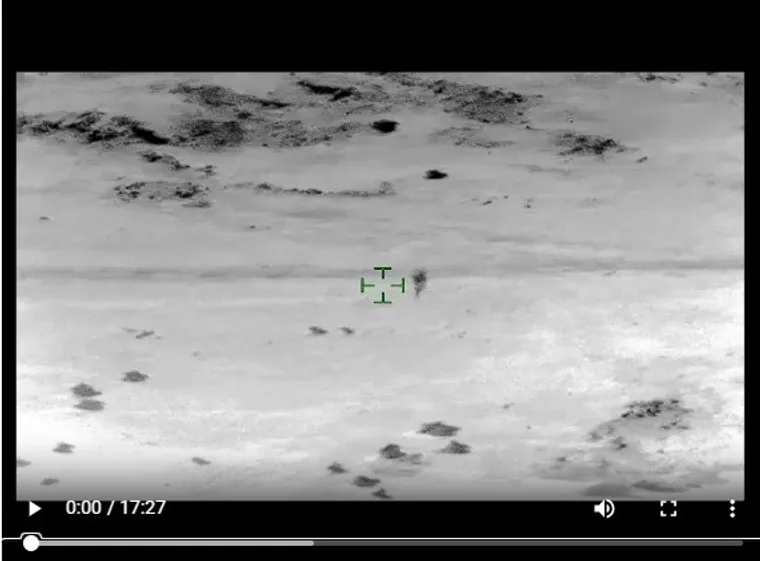
AARO's 'Al Taqaddum Object' case resolution (8 September 2025). AARO assesses with high confidence the 2017 infrared object over Iraq showed no anomalous behavior and was consistent with a cluster of inflated balloons.
Common questions
- What did AARO conclude about the object recorded over Al Taqaddum Air Base in 2017?
- AARO assesses with high confidence that the object did not exhibit anomalous speed or behavior, and that it was consistent with a cluster of fully and partially inflated balloons drifting east-to-west at roughly 4–14 mph with the wind.
- What sensors recorded the Al Taqaddum UAP and how long was the observation?
- The report states an infrared sensor aboard an aerostat force-protection blimp at 2,700 feet recorded the object for about 17 minutes 30 seconds on 23 October 2017.
- Did AARO consider a drone as an explanation for the Al Taqaddum object?
- The report states AARO and its partners considered but rejected a camouflaged-quadrotor-drone hypothesis, because the object drifted with the wind and showed no engine heat signature.
Source & Classification
Record metadata
- Record type
- Report landing
- Decade
- 2010s
- Review status
- published
- Publication status
- published
Official source link
https://www.aaro.mil/UAP-Cases/UAP-Case-Resolution-Reports/Preservation copy (PDF) ⬇ · 871 KB · 3 pp A local preservation copy of this public-domain U.S.-government document. The official source above is authoritative.
Documents are linked to their official source pages, with a local preservation copy of the public-domain U.S.-government document where available; the official source is authoritative. Videos are linked, not hosted. Copyright and license notes are recorded per source.
Topics
Cite this record View collection →
All-domain Anomaly Resolution Office (AARO). "AARO "Al Taqaddum Object" UAP Case Resolution Report". 2010s. Official source: https://www.aaro.mil/UAP-Cases/UAP-Case-Resolution-Reports/. Cataloged by the independent UAP Records Archive (not an official or government source): https://uap-archive.org/uap/records/aaro-al-taqaddam/.
APA
All-domain Anomaly Resolution Office (AARO). (2010s). AARO "Al Taqaddum Object" UAP Case Resolution Report. https://www.aaro.mil/UAP-Cases/UAP-Case-Resolution-Reports/
MLA
All-domain Anomaly Resolution Office (AARO). "AARO "Al Taqaddum Object" UAP Case Resolution Report." 2010s, https://www.aaro.mil/UAP-Cases/UAP-Case-Resolution-Reports/.
Chicago
All-domain Anomaly Resolution Office (AARO). "AARO "Al Taqaddum Object" UAP Case Resolution Report." 2010s. https://www.aaro.mil/UAP-Cases/UAP-Case-Resolution-Reports/.
BibTeX
@misc{uaprecords_aaro-al-taqaddam,
  title  = {AARO "Al Taqaddum Object" UAP Case Resolution Report},
  author = {All-domain Anomaly Resolution Office (AARO)},
  year   = {2010s},
  howpublished = {Official source: https://www.aaro.mil/UAP-Cases/UAP-Case-Resolution-Reports/},
  note   = {Cataloged by the independent UAP Records Archive — not an official or government source},
  url    = {https://uap-archive.org/uap/records/aaro-al-taqaddam/}
}
Embed this record
Copy this HTML to embed the record card with attribution on your site.
<figure style="max-width:600px;margin:0;"> <a href="https://uap-archive.org/uap/records/aaro-al-taqaddam/"><img src="https://uap-archive.org/og/records/aaro-al-taqaddam.png" alt="AARO "Al Taqaddum Object" UAP Case Resolution Report — UAP Records Archive" width="600" style="width:100%;height:auto;border:0;" loading="lazy"></a> <figcaption style="font-size:13px;line-height:1.5;">All-domain Anomaly Resolution Office (AARO). "AARO "Al Taqaddum Object" UAP Case Resolution Report". 2010s. Official source: https://www.aaro.mil/UAP-Cases/UAP-Case-Resolution-Reports/. Cataloged by the independent UAP Records Archive (not an official or government source): https://uap-archive.org/uap/records/aaro-al-taqaddam/. <a href="https://uap-archive.org/uap/records/aaro-al-taqaddam/">View record →</a></figcaption> </figure>
Related records
Evidence
License note (source-level)
AARO content is US Department of Defense work, generally public domain under 17 U.S.C. §105. DoD seal and identity usage is governed by 18 U.S.C. §701 and DoD Directive 5410.20 and is not used by this archive. License treatment for specific linked documents will be assessed before any indexed or monetized release.
Archivist note
AARO’s case resolution report for the “Al Taqaddum Object,” dated 8 September 2025. On 23 October 2017, an infrared sensor aboard an aerostat force-protection blimp at 2,700 feet over Al Taqaddum Air Base, Iraq, recorded about 17 minutes 30 seconds of an unidentified object. AARO assesses with high confidence the object did not exhibit anomalous behavior and was consistent with a cluster of fully and partially inflated balloons.
The full English text below is machine-extracted from the linked PDF for reference; the original document is authoritative. This archive links the official source and an archive snapshot, and does not reproduce the DoD or AARO visual identity.
Full text (machine-extracted)
Uncertainty / Limits
Archive state (this release)
- Official source aaro.mil ↗
- Archived 2025-09-19 ↗
- Added to archive
- Last revised
- Record status
- Official link verified
- Review status
- published
- Publication status
- published
- Local copy
- Preservation copy hosted on this site
- Summary
- Published
- Translation
- Published — View in 中文 →
Verify this document (SHA-256)
This archive recorded the SHA-256 checksum of the source PDF. Download the document and recompute its checksum — a matching value means the file is byte-for-byte identical to the one this record cites:
SHA-256 · 92336b800903827e3554c52fce7cb2eebe99556b9b8c67332174be05d4fd88ed
Preservation copy: /uap/docs/aaro-al-taqaddam.pdf ↗
# macOS / Linux / WSL
sha256sum aaro-al-taqaddam.pdf

# Windows PowerShell
Get-FileHash aaro-al-taqaddam.pdf -Algorithm SHA256
A matching checksum means the file is byte-for-byte identical to the archived document. It does not verify the truth of any statement in the document — only the integrity of the file.